Confirmed Measles Cases in Ashtabula and Tuscarawas Counties: Guidance for EMS Providers
- UH EMSI

- Jul 30
- 4 min read
Updated: Aug 6
Summary: Two measles cases have been confirmed in Ashtabula County and one in Tuscarawas County. EMS providers should stay alert for patients with febrile rash illness, especially those who are unvaccinated, recently traveled, or have had contact with a confirmed case. Measles spreads through airborne particles and droplets that linger up to two hours, and patients are contagious from four days before to four days after the rash appears. Mask suspected patients with a surgical mask, wear an N95 plus gloves, eye protection, and a fluid-resistant gown, avoid aerosol-generating procedures, maximize patient-compartment ventilation while isolating the driver, and notify the receiving hospital before arrival.
Confirmed Measles Cases
Two confirmed measles cases have been reported in Ashtabula County by the Ashtabula County Health Department, and a separate case has been confirmed in Tuscarawas County by the Tuscarawas County Health Department. The Ohio Department of Health is working with both county health departments to follow up on potential exposures and promote vaccination opportunities. Due to these cases and possible exposures in the community, increased awareness and precautions are recommended. First responders and healthcare providers should be alert for signs and symptoms of measles, particularly among persons who have not yet received measles vaccination (MMR).
Measles Epidemiology
Measles can be severe and is highly contagious. The virus is transmitted by direct contact with infectious droplets or by airborne spread when an infected person breathes, coughs, or sneezes.
Measles virus can remain active and contagious for up to 2 hours in the air or on surfaces. The time from exposure to the onset of a rash averages 14 days. People with measles are infectious from 4 days before symptom onset to 4 days after rash onset.
Clinical Features
Symptoms of measles before a rash develops (prodrome) include:
Fever (101 to 105 degrees)
Runny nose
Cough
Red, watery eyes
Koplik spots: blue-white spots on the bright red background of the buccal mucosa. These may be present, often before the rash develops, but are frequently not seen and are not required for the diagnosis of measles.

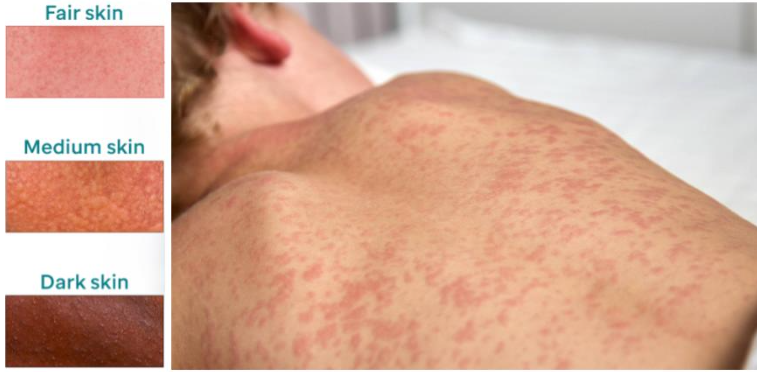
Image from JAMA Rash: A red, blotchy rash presents 3 to 7 days later and lasts 4 to 7 days. It usually starts on the face and proceeds down the body, involving the extremities last, and may include the palms and soles. The rash resolves in the same order that it appeared.

Screen Patient
Is the patient unvaccinated?
Did they recently travel?
Any contact with a confirmed measles case?
Did they have contact with a community likely to be unvaccinated?
Infection Control
Providers should remain vigilant for persons presenting with febrile and rash illness, particularly among people who reside in or have spent time in geographic areas experiencing measles outbreaks, have recently traveled internationally, or who were exposed to a person with febrile rash illness.
Measles is spread via airborne transmission and direct contact with infectious droplets.
EMS providers should take respiratory precautions using an N95 respirator mask.
Patients presenting with febrile rash illness should immediately be placed in a surgical mask and, when transporting a patient through the hospital, the patient should remain masked.
Ideally, the ambulance used to transport a patient with suspected measles infection should not be used for a period of 2 hours after the patient exits the vehicle, and the number of people entering and leaving the vehicle should be minimized; this may not always be possible.
Personal Protective Equipment
EMS providers are required to follow their local infectious disease emergency response plan. The following PPE is recommended for use by EMS when treating a patient with suspected measles infection:
Disposable exam gloves
Goggles or face shield
Disposable NIOSH-approved, fit-tested N95 respirator or PAPR
Disposable fluid-resistant gown that extends to at least mid-calf, or disposable fluid-resistant coveralls
Patient Care Considerations
Anyone with measles can have serious complications, but those under 5 years old and those older than 20 are at greatest risk, along with pregnant women and any immunocompromised individuals. Complications may include ear infections, diarrhea, pneumonia, encephalitis, and deafness or cognitive disability.
Provide a surgical mask (N95 is not recommended) for all patients with febrile rash illness.
Provide tissues to patients for secretion control and encourage patient hand hygiene and cough etiquette practices.
The performance of aerosol-generating procedures, such as endotracheal intubation and open suctioning of the respiratory tract, should be avoided unless medically indicated.
Patients who are intubated should be ventilated with a bag-valve device or ventilator equipped with a HEPA filter on the exhalation port.
Transport Considerations
Standard transportation to appropriate hospital receiving facility.
It is recommended to have the patient compartment exhaust vent on high and to isolate the driver compartment from the patient compartment. It is also recommended to have the driver compartment ventilation fan set to high without recirculation.
When providing hospital pre-notification, please indicate if any family or supports are accompanying the patient, as they too may need to be isolated and follow the agency plan.
Hospital Notification
EMS personnel must notify the receiving hospital before arrival if they are transporting a patient with febrile and rash illness, with or without a rash, to their facility.
Decontamination Considerations
Follow agency decontamination procedures after transfer of the patient.
Measles vaccination
All individuals, including children, adolescents, and adults born in 1957 or later, who lack proof of vaccination (two doses, 28 days apart), or laboratory evidence of immunity or prior disease, should receive the MMR vaccine.
Individuals born before 1957 are typically considered immune due to prior exposure to the diseases; however, this does not apply to healthcare workers. Healthcare workers of any age must have documented proof of vaccination or laboratory evidence of immunity or prior disease.
Main contraindications to MMR vaccination include severe allergic reactions to the vaccine, pregnancy, and severe immunocompromised conditions (due to the live vaccine).
Following measles exposure, post-exposure prophylaxis for susceptible individuals without contraindications should consist of MMR vaccination within 72 hours of exposure.
Immune globulin can be administered within six days of exposure to prevent or reduce the severity of measles in non-immune individuals, though vaccination is preferred when within the post-exposure window.
During a measles outbreak, adults who are inadequately immunized should receive two doses of MMR, spaced at least 28 days apart.